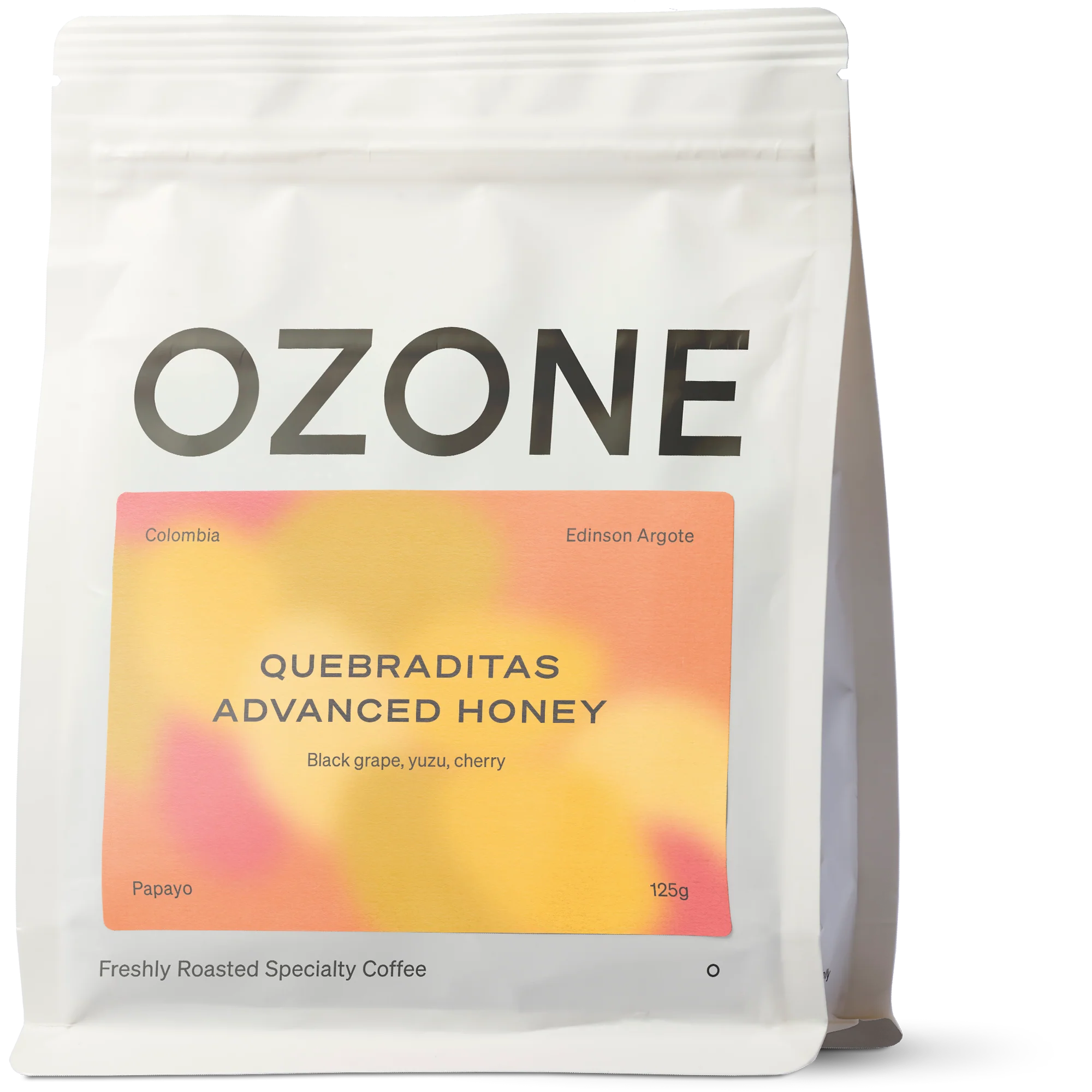
Colombia: Quebraditas, Papayo, Advanced Honey [125g]
Colombia: Quebraditas, Papayo, Advanced Honey
*Our Special Reserve coffees are offered in 125g bags - a smaller measure that reflects their rarity and quality, and a way to make these exceptional lots more accessible to those seeking something truly unique*
This complex cup is full of bold flavours. Starting with sour cherry sweets and a creamy body, the processing adds a definite funky edge. The finish is crisp grapefruit, with the tropical citrus of yuzu on the aftertaste. As it cools, the cherry gives way to black grape and extra layers of candy sweetness develop, whilst the grapefruit opens up into full, perfume like florals.
A First For Quebraditas
Twenty kilos. That's all we have. So before we get into the why of this coffee, here's the headline: this is the first honey-processed coffee ever produced at Quebraditas, and it's a Papayo. If you've been following Edinson Argote's work, you'll already know that's a significant pairing. If you haven't, settle in.
Edinson Argote – The Producer
Edinson's story is the kind that gets retold a lot in specialty coffee circles, and for good reason. Originally from San Adolfo in Huila, he was orphaned at three when his mother passed away and was raised by his sister. He left home at eleven to find work, spent his teenage years moving between jobs, and at eighteen joined the Colombian Army, completing eighteen months of service before being discharged.
His first proper introduction to coffee came at twenty, working at his cousin's buying station in Acevedo, Huila. The job itself was largely physical (loading and unloading sacks) but in the quieter moments he started pulling apart what made one coffee different from another, taking cupping courses to sharpen his palate and getting properly hooked on the sensory side of things. From there, he moved into the Cauca region, working on some of the most progressive and experimental farms in Colombian specialty coffee. He climbed quickly, eventually running quality and processing control at one of them, picking up the technical and fermentation expertise that now defines his work. The whole time, the goal was always the same: to one day run his own.
That moment came when he met his partner, who comes from a coffee-growing family in Oporapa, Huila. Her family already had a traditional farm called Chorro Alto, and together they founded Quebraditas Coffee Farm – a project built around exotic varietals and the kind of high-precision coffee processing techniques Edinson had spent years mastering. He's also become something of a quiet mentor in the region, sharing his processing know-how with neighbouring farms and helping push Oporapa towards wider recognition in the specialty coffee world.
Quebraditas – The Farm
The Quebraditas project actually spans two adjoining farms in the mountains around Oporapa, Huila. Chorro Alto, the original family farm, is around 10 hectares of more traditional varieties like Caturra and Colombia. Quebraditas itself is an additional 8 hectares that Edinson and his partner planted out almost entirely with exotic and rare coffee varietals. Together, the farms cover roughly 18 hectares between 1,600 and 1,850 metres above sea level – a stretch of the central Huila mountains that's quietly building a serious reputation, even if Oporapa still doesn't carry the same name recognition as Acevedo or Pitalito.
The varietal list reads like a wishlist for anyone who follows rare coffees: Gesha, Bourbon Sidra, Bourbon Pointu, Eugenioides, Wush Wush, Sudan Rume, Pacamara, Java, Bourbon Chiroso, Laurina, and (of course) Papayo. The long-term plan is to gradually phase out the traditional varieties entirely and commit the whole 18 hectares to rare coffee cultivars. Alongside the planting, the agronomic side gets just as much attention as the processing: strategic shade canopies, organic inputs, soil pH and calcium management, and a general philosophy that the cup quality is decided in the soil long before the coffee cherries reach the fermentation tanks.
The processing facility itself sits on what used to be pastureland at Chorro Alto and includes an on-site laboratory for cupping and quality control. It's a working farm in the most literal sense - partners are welcome to visit, walk the rows, and see the whole operation from cherry to dry parchment. That kind of openness isn't universal in specialty coffee, and it tells you something about how Edinson and his team think about their work: nothing to hide, everything to learn from.
Papayo – The Varietal
Papayo is one of those varietals that's only really started getting its moment in the last few years. It's named for its cherries, which are unusually elongated and said to resemble small ripe papayas. Beyond that, the story gets murky - in a good way.
It was originally assumed to be a Caturra mutation, but genetic work by World Coffee Research has since pointed to a much closer relationship with Ethiopian landrace varietals. How exactly an Ethiopian landrace ended up taking root in southern Huila is still up for debate. The most plausible theory points to a rumoured research farm near Acevedo that, decades ago, was apparently breeding and trialling varietals from around the world. Plants, as plants do, found their way into the surrounding hills.
It's still genuinely rare. Yields are low, it's mostly found on smallholder plots in and around Acevedo, and most of what gets exported is destined for competition lots, micro-lots, and the kind of small-batch releases that disappear quickly. It's also been turning up on barista championship stages with increasing regularity, which has done its profile no harm at all.
The Advanced Honey Process
Honey processed coffee, in its standard form, sits between washed and natural - cherries are depulped but the sticky mucilage is left clinging to the parchment as it dries. It's a technique that's been around for decades, particularly in Central America, and it tends to produce coffees with a sweetness and body that splits the difference between the two extremes.
"Advanced" honey, as practiced at Quebraditas, is a different beast. Every stage - oxidation, fermentation, drying, stabilisation - is measured, inoculated, and temperature-controlled. pH, temperature, and Brix are monitored continuously. The aim is a cleaner, more expressive cup that can be replicated lot after lot, rather than left to the variables of weather and intuition.
What makes it "advanced" rather than just careful is the level of intervention at each step. The 48-hour oxidation phase, before the cherries are even depulped, gives time for cell walls to soften and enzymatic activity to begin shaping the flavour profile from inside the fruit. The fermentation isn't left to wild yeasts drifting in from the environment, which is how a lot of natural and honey processes traditionally work; instead, a specific yeast strain is introduced alongside a measured dose of sugar, giving the producer real control over what's actually doing the work and how fast it's happening. Brix readings track the sugar conversion, pH tracks the acid development, and temperature is held steady so nothing stalls or runs away. Then the mechanical drying - stepped from 39°C down to 36°C across 72 hours - does what sun-drying on patios or raised beds can't reliably guarantee: a slow, even moisture loss with no hot spots, no surface crusting, and no risk of weather throwing the whole batch off course. The final rest in GrainPro bags lets internal moisture redistribute before milling, which sounds like a small detail but makes a real difference to how the green coffee holds up in transit and on the roaster.
Here's how this particular lot was put together:
- Harvest: Cherries hand-picked at a minimum of 90% ripeness, sorted for uniform sugar content.
- Floating: A density sort to remove underripes, floaters, and anything defective.
- Oxidation: 48 hours in clean bags, allowing the cherries to begin developing flavour before processing proper kicks off.
- Pulping: The skin comes off, but the mucilage stays on the parchment - the defining move of any honey process.
- Fermentation: 72 hours in food-grade plastic drums, with sugar and a specific yeast strain added to guide the process and keep things consistent.
- Drying: Mechanical, and carefully stepped - 48 hours at 39°C, then 24 hours at 36°C, for a slow and even finish.
- Stabilisation: Resting in GrainPro bags before milling, to let moisture even out and flavours settle.
What makes this lot particularly significant is that it's the first honey coffee Quebraditas has ever produced. Until now, the farm has built its name on washed and natural processes. Treating Papayo coffee – a varietal that already commands attention – as the debut canvas for a brand-new process is a properly bold move. It's the kind of thing that only really makes sense when the producer has the skill and the discipline to back it up.
One Last Thing
We've got 20kg of this. That's it. Once it's gone, it's gone - and given that it's both a debut process for Quebraditas and a varietal that doesn't come around all that often, we'd recommend not sleeping on it.
Traceability
- Country: Colombia
- Region: Huila
- Town: Oporapa
- Producer: Edinson Argote
- Co-producer: Luz Angela Rojas
- Farm: Quebraditas
- Elevation: 1,850 m.a.s.l
- Soil: Volcanic, mineral-rich
- Variety: Papayo
- Processing method: Advanced Honey
Roast Information
Medium
Roasted with a balanced, measured approach, this coffee moves cleanly through first crack and well into the gap, giving plenty of space for the Papayo varietal and the advanced honey process to express themselves fully. We’ve developed it far enough to bring out the lush sweetness and creamy structure that honey processing excels at, but without pushing the roast to a point where the finer details get smoothed over.
The aim here is clarity rather than control: enough heat to anchor the cup and support the intense fruit character, while keeping the profile open, aromatic and layered. That allows the sour‑cherry brightness, grapefruit acidity and floral, candy‑like sweetness to stay distinct, rather than collapsing into a single dominant note. If you enjoy coffees that are complex, expressive and flavour‑forward - but still beautifully balanced - this roast keeps out of the way and lets the coffee speak for itself.
Cupping Scores
Tasting Notes: Black grape, yuzu, cherry.
Cup of Excellence Cupping Scores
- Clean cup: 8/8
- Sweetness: 7/8
- Acidity: 7/8
- Mouthfeel: 6/8
- Flavour: 7/8
- Aftertaste: 6/8
- Balance: 6/8
- Overall: 7/8
- Correction: +36
- Total: 90/100
If you would like to find out more about how we score coffees, and why this coffee scoring 90 points is a big deal, make sure to read our blog post "What Do Coffee Cuppings Scores Actually Mean?" by clicking here.
Colombia: Quebraditas, Papayo, Advanced Honey
*Our Special Reserve coffees are offered in 125g bags - a smaller measure that reflects their rarity and quality, and a way to make these exceptional lots more accessible to those seeking something truly unique*
This complex cup is full of bold flavours. Starting with sour cherry sweets and a creamy body, the processing adds a definite funky edge. The finish is crisp grapefruit, with the tropical citrus of yuzu on the aftertaste. As it cools, the cherry gives way to black grape and extra layers of candy sweetness develop, whilst the grapefruit opens up into full, perfume like florals.
A First For Quebraditas
Twenty kilos. That's all we have. So before we get into the why of this coffee, here's the headline: this is the first honey-processed coffee ever produced at Quebraditas, and it's a Papayo. If you've been following Edinson Argote's work, you'll already know that's a significant pairing. If you haven't, settle in.
Edinson Argote – The Producer
Edinson's story is the kind that gets retold a lot in specialty coffee circles, and for good reason. Originally from San Adolfo in Huila, he was orphaned at three when his mother passed away and was raised by his sister. He left home at eleven to find work, spent his teenage years moving between jobs, and at eighteen joined the Colombian Army, completing eighteen months of service before being discharged.
His first proper introduction to coffee came at twenty, working at his cousin's buying station in Acevedo, Huila. The job itself was largely physical (loading and unloading sacks) but in the quieter moments he started pulling apart what made one coffee different from another, taking cupping courses to sharpen his palate and getting properly hooked on the sensory side of things. From there, he moved into the Cauca region, working on some of the most progressive and experimental farms in Colombian specialty coffee. He climbed quickly, eventually running quality and processing control at one of them, picking up the technical and fermentation expertise that now defines his work. The whole time, the goal was always the same: to one day run his own.
That moment came when he met his partner, who comes from a coffee-growing family in Oporapa, Huila. Her family already had a traditional farm called Chorro Alto, and together they founded Quebraditas Coffee Farm – a project built around exotic varietals and the kind of high-precision coffee processing techniques Edinson had spent years mastering. He's also become something of a quiet mentor in the region, sharing his processing know-how with neighbouring farms and helping push Oporapa towards wider recognition in the specialty coffee world.
Quebraditas – The Farm
The Quebraditas project actually spans two adjoining farms in the mountains around Oporapa, Huila. Chorro Alto, the original family farm, is around 10 hectares of more traditional varieties like Caturra and Colombia. Quebraditas itself is an additional 8 hectares that Edinson and his partner planted out almost entirely with exotic and rare coffee varietals. Together, the farms cover roughly 18 hectares between 1,600 and 1,850 metres above sea level – a stretch of the central Huila mountains that's quietly building a serious reputation, even if Oporapa still doesn't carry the same name recognition as Acevedo or Pitalito.
The varietal list reads like a wishlist for anyone who follows rare coffees: Gesha, Bourbon Sidra, Bourbon Pointu, Eugenioides, Wush Wush, Sudan Rume, Pacamara, Java, Bourbon Chiroso, Laurina, and (of course) Papayo. The long-term plan is to gradually phase out the traditional varieties entirely and commit the whole 18 hectares to rare coffee cultivars. Alongside the planting, the agronomic side gets just as much attention as the processing: strategic shade canopies, organic inputs, soil pH and calcium management, and a general philosophy that the cup quality is decided in the soil long before the coffee cherries reach the fermentation tanks.
The processing facility itself sits on what used to be pastureland at Chorro Alto and includes an on-site laboratory for cupping and quality control. It's a working farm in the most literal sense - partners are welcome to visit, walk the rows, and see the whole operation from cherry to dry parchment. That kind of openness isn't universal in specialty coffee, and it tells you something about how Edinson and his team think about their work: nothing to hide, everything to learn from.
Papayo – The Varietal
Papayo is one of those varietals that's only really started getting its moment in the last few years. It's named for its cherries, which are unusually elongated and said to resemble small ripe papayas. Beyond that, the story gets murky - in a good way.
It was originally assumed to be a Caturra mutation, but genetic work by World Coffee Research has since pointed to a much closer relationship with Ethiopian landrace varietals. How exactly an Ethiopian landrace ended up taking root in southern Huila is still up for debate. The most plausible theory points to a rumoured research farm near Acevedo that, decades ago, was apparently breeding and trialling varietals from around the world. Plants, as plants do, found their way into the surrounding hills.
It's still genuinely rare. Yields are low, it's mostly found on smallholder plots in and around Acevedo, and most of what gets exported is destined for competition lots, micro-lots, and the kind of small-batch releases that disappear quickly. It's also been turning up on barista championship stages with increasing regularity, which has done its profile no harm at all.
The Advanced Honey Process
Honey processed coffee, in its standard form, sits between washed and natural - cherries are depulped but the sticky mucilage is left clinging to the parchment as it dries. It's a technique that's been around for decades, particularly in Central America, and it tends to produce coffees with a sweetness and body that splits the difference between the two extremes.
"Advanced" honey, as practiced at Quebraditas, is a different beast. Every stage - oxidation, fermentation, drying, stabilisation - is measured, inoculated, and temperature-controlled. pH, temperature, and Brix are monitored continuously. The aim is a cleaner, more expressive cup that can be replicated lot after lot, rather than left to the variables of weather and intuition.
What makes it "advanced" rather than just careful is the level of intervention at each step. The 48-hour oxidation phase, before the cherries are even depulped, gives time for cell walls to soften and enzymatic activity to begin shaping the flavour profile from inside the fruit. The fermentation isn't left to wild yeasts drifting in from the environment, which is how a lot of natural and honey processes traditionally work; instead, a specific yeast strain is introduced alongside a measured dose of sugar, giving the producer real control over what's actually doing the work and how fast it's happening. Brix readings track the sugar conversion, pH tracks the acid development, and temperature is held steady so nothing stalls or runs away. Then the mechanical drying - stepped from 39°C down to 36°C across 72 hours - does what sun-drying on patios or raised beds can't reliably guarantee: a slow, even moisture loss with no hot spots, no surface crusting, and no risk of weather throwing the whole batch off course. The final rest in GrainPro bags lets internal moisture redistribute before milling, which sounds like a small detail but makes a real difference to how the green coffee holds up in transit and on the roaster.
Here's how this particular lot was put together:
- Harvest: Cherries hand-picked at a minimum of 90% ripeness, sorted for uniform sugar content.
- Floating: A density sort to remove underripes, floaters, and anything defective.
- Oxidation: 48 hours in clean bags, allowing the cherries to begin developing flavour before processing proper kicks off.
- Pulping: The skin comes off, but the mucilage stays on the parchment - the defining move of any honey process.
- Fermentation: 72 hours in food-grade plastic drums, with sugar and a specific yeast strain added to guide the process and keep things consistent.
- Drying: Mechanical, and carefully stepped - 48 hours at 39°C, then 24 hours at 36°C, for a slow and even finish.
- Stabilisation: Resting in GrainPro bags before milling, to let moisture even out and flavours settle.
What makes this lot particularly significant is that it's the first honey coffee Quebraditas has ever produced. Until now, the farm has built its name on washed and natural processes. Treating Papayo coffee – a varietal that already commands attention – as the debut canvas for a brand-new process is a properly bold move. It's the kind of thing that only really makes sense when the producer has the skill and the discipline to back it up.
One Last Thing
We've got 20kg of this. That's it. Once it's gone, it's gone - and given that it's both a debut process for Quebraditas and a varietal that doesn't come around all that often, we'd recommend not sleeping on it.
Traceability
- Country: Colombia
- Region: Huila
- Town: Oporapa
- Producer: Edinson Argote
- Co-producer: Luz Angela Rojas
- Farm: Quebraditas
- Elevation: 1,850 m.a.s.l
- Soil: Volcanic, mineral-rich
- Variety: Papayo
- Processing method: Advanced Honey
Roast Information
Medium
Roasted with a balanced, measured approach, this coffee moves cleanly through first crack and well into the gap, giving plenty of space for the Papayo varietal and the advanced honey process to express themselves fully. We’ve developed it far enough to bring out the lush sweetness and creamy structure that honey processing excels at, but without pushing the roast to a point where the finer details get smoothed over.
The aim here is clarity rather than control: enough heat to anchor the cup and support the intense fruit character, while keeping the profile open, aromatic and layered. That allows the sour‑cherry brightness, grapefruit acidity and floral, candy‑like sweetness to stay distinct, rather than collapsing into a single dominant note. If you enjoy coffees that are complex, expressive and flavour‑forward - but still beautifully balanced - this roast keeps out of the way and lets the coffee speak for itself.
Cupping Scores
Tasting Notes: Black grape, yuzu, cherry.
Cup of Excellence Cupping Scores
- Clean cup: 8/8
- Sweetness: 7/8
- Acidity: 7/8
- Mouthfeel: 6/8
- Flavour: 7/8
- Aftertaste: 6/8
- Balance: 6/8
- Overall: 7/8
- Correction: +36
- Total: 90/100
If you would like to find out more about how we score coffees, and why this coffee scoring 90 points is a big deal, make sure to read our blog post "What Do Coffee Cuppings Scores Actually Mean?" by clicking here.
Original: $21.72
-65%$21.72
$7.60Description
Colombia: Quebraditas, Papayo, Advanced Honey
*Our Special Reserve coffees are offered in 125g bags - a smaller measure that reflects their rarity and quality, and a way to make these exceptional lots more accessible to those seeking something truly unique*
This complex cup is full of bold flavours. Starting with sour cherry sweets and a creamy body, the processing adds a definite funky edge. The finish is crisp grapefruit, with the tropical citrus of yuzu on the aftertaste. As it cools, the cherry gives way to black grape and extra layers of candy sweetness develop, whilst the grapefruit opens up into full, perfume like florals.
A First For Quebraditas
Twenty kilos. That's all we have. So before we get into the why of this coffee, here's the headline: this is the first honey-processed coffee ever produced at Quebraditas, and it's a Papayo. If you've been following Edinson Argote's work, you'll already know that's a significant pairing. If you haven't, settle in.
Edinson Argote – The Producer
Edinson's story is the kind that gets retold a lot in specialty coffee circles, and for good reason. Originally from San Adolfo in Huila, he was orphaned at three when his mother passed away and was raised by his sister. He left home at eleven to find work, spent his teenage years moving between jobs, and at eighteen joined the Colombian Army, completing eighteen months of service before being discharged.
His first proper introduction to coffee came at twenty, working at his cousin's buying station in Acevedo, Huila. The job itself was largely physical (loading and unloading sacks) but in the quieter moments he started pulling apart what made one coffee different from another, taking cupping courses to sharpen his palate and getting properly hooked on the sensory side of things. From there, he moved into the Cauca region, working on some of the most progressive and experimental farms in Colombian specialty coffee. He climbed quickly, eventually running quality and processing control at one of them, picking up the technical and fermentation expertise that now defines his work. The whole time, the goal was always the same: to one day run his own.
That moment came when he met his partner, who comes from a coffee-growing family in Oporapa, Huila. Her family already had a traditional farm called Chorro Alto, and together they founded Quebraditas Coffee Farm – a project built around exotic varietals and the kind of high-precision coffee processing techniques Edinson had spent years mastering. He's also become something of a quiet mentor in the region, sharing his processing know-how with neighbouring farms and helping push Oporapa towards wider recognition in the specialty coffee world.
Quebraditas – The Farm
The Quebraditas project actually spans two adjoining farms in the mountains around Oporapa, Huila. Chorro Alto, the original family farm, is around 10 hectares of more traditional varieties like Caturra and Colombia. Quebraditas itself is an additional 8 hectares that Edinson and his partner planted out almost entirely with exotic and rare coffee varietals. Together, the farms cover roughly 18 hectares between 1,600 and 1,850 metres above sea level – a stretch of the central Huila mountains that's quietly building a serious reputation, even if Oporapa still doesn't carry the same name recognition as Acevedo or Pitalito.
The varietal list reads like a wishlist for anyone who follows rare coffees: Gesha, Bourbon Sidra, Bourbon Pointu, Eugenioides, Wush Wush, Sudan Rume, Pacamara, Java, Bourbon Chiroso, Laurina, and (of course) Papayo. The long-term plan is to gradually phase out the traditional varieties entirely and commit the whole 18 hectares to rare coffee cultivars. Alongside the planting, the agronomic side gets just as much attention as the processing: strategic shade canopies, organic inputs, soil pH and calcium management, and a general philosophy that the cup quality is decided in the soil long before the coffee cherries reach the fermentation tanks.
The processing facility itself sits on what used to be pastureland at Chorro Alto and includes an on-site laboratory for cupping and quality control. It's a working farm in the most literal sense - partners are welcome to visit, walk the rows, and see the whole operation from cherry to dry parchment. That kind of openness isn't universal in specialty coffee, and it tells you something about how Edinson and his team think about their work: nothing to hide, everything to learn from.
Papayo – The Varietal
Papayo is one of those varietals that's only really started getting its moment in the last few years. It's named for its cherries, which are unusually elongated and said to resemble small ripe papayas. Beyond that, the story gets murky - in a good way.
It was originally assumed to be a Caturra mutation, but genetic work by World Coffee Research has since pointed to a much closer relationship with Ethiopian landrace varietals. How exactly an Ethiopian landrace ended up taking root in southern Huila is still up for debate. The most plausible theory points to a rumoured research farm near Acevedo that, decades ago, was apparently breeding and trialling varietals from around the world. Plants, as plants do, found their way into the surrounding hills.
It's still genuinely rare. Yields are low, it's mostly found on smallholder plots in and around Acevedo, and most of what gets exported is destined for competition lots, micro-lots, and the kind of small-batch releases that disappear quickly. It's also been turning up on barista championship stages with increasing regularity, which has done its profile no harm at all.
The Advanced Honey Process
Honey processed coffee, in its standard form, sits between washed and natural - cherries are depulped but the sticky mucilage is left clinging to the parchment as it dries. It's a technique that's been around for decades, particularly in Central America, and it tends to produce coffees with a sweetness and body that splits the difference between the two extremes.
"Advanced" honey, as practiced at Quebraditas, is a different beast. Every stage - oxidation, fermentation, drying, stabilisation - is measured, inoculated, and temperature-controlled. pH, temperature, and Brix are monitored continuously. The aim is a cleaner, more expressive cup that can be replicated lot after lot, rather than left to the variables of weather and intuition.
What makes it "advanced" rather than just careful is the level of intervention at each step. The 48-hour oxidation phase, before the cherries are even depulped, gives time for cell walls to soften and enzymatic activity to begin shaping the flavour profile from inside the fruit. The fermentation isn't left to wild yeasts drifting in from the environment, which is how a lot of natural and honey processes traditionally work; instead, a specific yeast strain is introduced alongside a measured dose of sugar, giving the producer real control over what's actually doing the work and how fast it's happening. Brix readings track the sugar conversion, pH tracks the acid development, and temperature is held steady so nothing stalls or runs away. Then the mechanical drying - stepped from 39°C down to 36°C across 72 hours - does what sun-drying on patios or raised beds can't reliably guarantee: a slow, even moisture loss with no hot spots, no surface crusting, and no risk of weather throwing the whole batch off course. The final rest in GrainPro bags lets internal moisture redistribute before milling, which sounds like a small detail but makes a real difference to how the green coffee holds up in transit and on the roaster.
Here's how this particular lot was put together:
- Harvest: Cherries hand-picked at a minimum of 90% ripeness, sorted for uniform sugar content.
- Floating: A density sort to remove underripes, floaters, and anything defective.
- Oxidation: 48 hours in clean bags, allowing the cherries to begin developing flavour before processing proper kicks off.
- Pulping: The skin comes off, but the mucilage stays on the parchment - the defining move of any honey process.
- Fermentation: 72 hours in food-grade plastic drums, with sugar and a specific yeast strain added to guide the process and keep things consistent.
- Drying: Mechanical, and carefully stepped - 48 hours at 39°C, then 24 hours at 36°C, for a slow and even finish.
- Stabilisation: Resting in GrainPro bags before milling, to let moisture even out and flavours settle.
What makes this lot particularly significant is that it's the first honey coffee Quebraditas has ever produced. Until now, the farm has built its name on washed and natural processes. Treating Papayo coffee – a varietal that already commands attention – as the debut canvas for a brand-new process is a properly bold move. It's the kind of thing that only really makes sense when the producer has the skill and the discipline to back it up.
One Last Thing
We've got 20kg of this. That's it. Once it's gone, it's gone - and given that it's both a debut process for Quebraditas and a varietal that doesn't come around all that often, we'd recommend not sleeping on it.
Traceability
- Country: Colombia
- Region: Huila
- Town: Oporapa
- Producer: Edinson Argote
- Co-producer: Luz Angela Rojas
- Farm: Quebraditas
- Elevation: 1,850 m.a.s.l
- Soil: Volcanic, mineral-rich
- Variety: Papayo
- Processing method: Advanced Honey
Roast Information
Medium
Roasted with a balanced, measured approach, this coffee moves cleanly through first crack and well into the gap, giving plenty of space for the Papayo varietal and the advanced honey process to express themselves fully. We’ve developed it far enough to bring out the lush sweetness and creamy structure that honey processing excels at, but without pushing the roast to a point where the finer details get smoothed over.
The aim here is clarity rather than control: enough heat to anchor the cup and support the intense fruit character, while keeping the profile open, aromatic and layered. That allows the sour‑cherry brightness, grapefruit acidity and floral, candy‑like sweetness to stay distinct, rather than collapsing into a single dominant note. If you enjoy coffees that are complex, expressive and flavour‑forward - but still beautifully balanced - this roast keeps out of the way and lets the coffee speak for itself.
Cupping Scores
Tasting Notes: Black grape, yuzu, cherry.
Cup of Excellence Cupping Scores
- Clean cup: 8/8
- Sweetness: 7/8
- Acidity: 7/8
- Mouthfeel: 6/8
- Flavour: 7/8
- Aftertaste: 6/8
- Balance: 6/8
- Overall: 7/8
- Correction: +36
- Total: 90/100
If you would like to find out more about how we score coffees, and why this coffee scoring 90 points is a big deal, make sure to read our blog post "What Do Coffee Cuppings Scores Actually Mean?" by clicking here.