Bolivia: Don Carlos, Coco Natural
Bolivia: Don Carlos, Catuai, Coco Natural
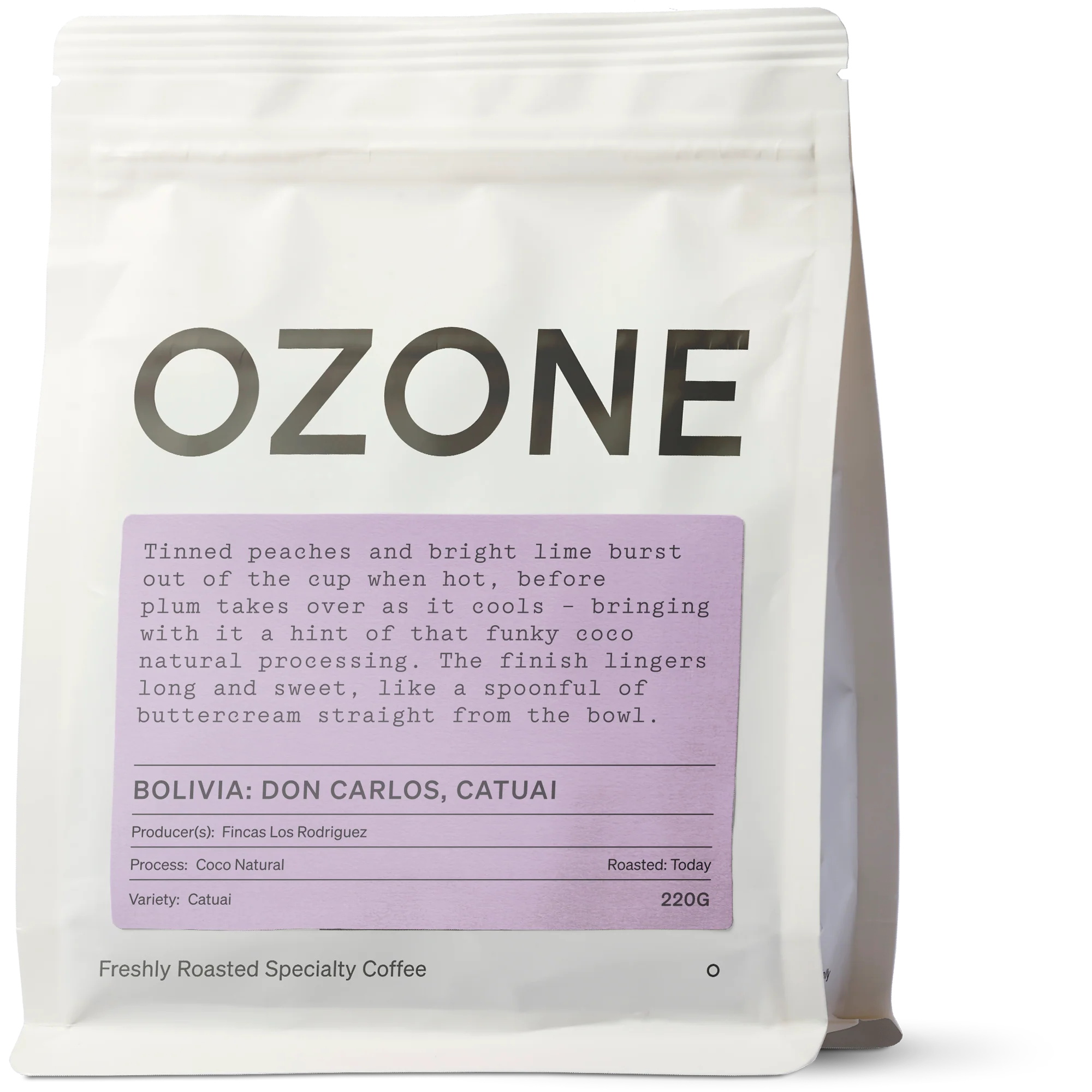
Tinned peaches and bright lime burst out of the cup when hot, before plum takes over as it cools – bringing with it a hint of that funky coco natural processing. The finish lingers long and sweet, like a spoonful of buttercream straight from the bowl.
This Coco Natural Catuai lot was grown at Finca Don Carlos, nestled in the Bolinda colony of Caranavi, Bolivia. The farm is part of Agricafe’s Buena Vista program, their ambitious project to revive Bolivia’s declining coffee trade. Pedro Rodríguez, along with his daughter Daniela and son Pedro Pablo (who runs Don Carlos) are the driving force behind Agricafe and Fincas Los Rodríguez. Theirs is a story of innovation and a deep commitment to revitalising the Bolivian specialty coffee industry that was, not so long ago, on the verge of disappearing entirely.
A Farm Worthy Of Don Carlos
The Caranavi province sits towards the western edge of Bolivia, on the eastern slopes of the Andes mountain range. Caranavi means "high place" in the Aymara language, one of the indigenous languages spoken in Bolivia. Caranavi province sits in a transitional zone between the high Andes and the Amazon basin, it’s known for its lush vegetation and has been dubbed the "Coffee Capital of Bolivia" for its ideal growing conditions and over 13,000 hectares of plantations.
Finca Don Carlos is spread over 18.7 hectares situated at 1,550-1,650 metres above sea level. This Bolivian coffee farm benefits from a microclimate of cool mountain air and rich volcanic soil, perfect conditions that contribute to its vibrant acidity and clean, structured cup profile. In addition to coffee, the farm is committed to environmental stewardship, with active reforestation efforts planting native species such as Tajibos, Mara, and Ceibo to preserve biodiversity and support long-term soil health.
Finca Don Carlos is named in honour of Carlos Mariaca, the oldest and most unconditionally awesome employee of Agricafe. He was there at the start of the specialty coffee trend and, together with Pedro Rodriguez (the founder of Agricafe) helped to build the wet mill in Caranavi. As a tribute to his legacy within Bolivian specialty coffee and to show their gratitude for all his good work, the company decided to give him partnership of the farm. His name has since been synonymous with delicious Bolivian coffee.
The Buena Vista Project
The Rodriguez family have been sourcing coffee from small coffee producers in the Caranavi and Samaipata regions for three decades, but the steady decline of coffee production put the sustainability of their export business in jeopardy. Daniela and Pedro bought land in the Caranavi region to showcase modern practices and educate other producers in sustainable farming, as well as increasing the overall volume at their mills. They have twelve farms in total, and Finca Don Caros is one of eight in the Caranavi region, the project's second farm overall. Pedro Pablo studied agronomy in Honduras and brought techniques he had learnt there to the Buena Vista farms.
Rather than following traditional Bolivian Coffee farming practices common in the region, they took an extremely methodical, innovative and scientific approach. They consulted leading specialty coffee agronomists from around the world, trialled different varieties and techniques, and carefully documented everything they learned. The results were extraordinary. Their farms became some of the most organised and beautiful in the country - coffee planted in neat rows, meticulously separated by variety, vibrant and healthy and producing exceptional quality and yields. The family also made a commitment to conservation from the outset, aiming to keep 60% of their land as nature reserves with coffee planted as agroforest amongst the trees.
What Is Coco Natural Processing?
The meticulous processing carried out at the Buena Vista mill manages the fermentation, depulping and drying processes to ensure exceptional quality - aided by their onsite laboratory where the coffee is analysed daily and its progress tracked. Through their exacting systems and traceability, alongside a world-class cupping team, they've been able to refine their techniques whilst continuing to learn for the future.
Processing coffee in the Natural style isn’t common in Bolivia and it presents a number of challenges with the local conditions. The Rodriguez family saw the value that Natural (and Honey) processed coffees could bring in terms of diversifying the range of flavours you get, so they decided to invest both money and effort into creating a way of doing these processes which would work in Bolivia. When they were asked about this new method of processing their coffee, they called it “Coco” - so in fact all the Natural processed coffee we have from Bolivia could also be nicknamed “Coco Processed”.
Only the very ripest cherries can be used for this process so meticulous control is necessary from the very beginning. Ripeness is checked both by colour and using measurement of the sugar content of the fruit. Under Bolivian climatic conditions only small batches of Naturals can be carried out at a time, weather reports are consulted so they know to expect a period without rain when the selected cherries can be reliably laid out on raised beds in the sun.
This Bolivian Coco Natural coffee was prepared using an Oxidation-Fermentation regime. This process was developed at the mill some years back and then continually refined until we have what you see today! Adrian explained to us that the goal here is to manipulate the two phases of flavour development - Oxidation and Fermentation. On arrival, the coffee oxidises as it undergoes the initial pre-drying stage. This short period (between 1 and 3 days, depending on the weather) outside rapidly reduces the moisture content in the fruit to prevent defects. Careful management of the coffee at this stage, including turning every 30 minutes and additional sorting of under/over-ripes, preserves the complex carbohydrates in the cherry which will be the precursors of flavour. After this, it is moved to the Coco driers - static wooden boxes with a metal grill at the base allowing air to be blown through. With this precise control of air movement and temperature around the beans the fermentation stage can now be extended and controlled. The driers hold the cherries below 40C for the 40 to 50 hours needed, and staff turn the cherries hourly, allowing bold flavours to develop without sacrificing clarity and crispness of the cup.
This same processing, used on a Pacamara from the previous harvest, was used by the 2025 Bolivian Barista Champion, Nicolas Varoch, for his winning routine. We were lucky enough to watch it at the Santa Cruz coffee festival the day before we went to see the farms!
Traceability
- Country: Bolivia
- Municipality: Caranavi
- Colonia: Bolinda
- Producer: Agricafe
- Farm: Don Carlos
- Producer: Carlos Mariaca
- Elevation: 1,550 – 1,650 m.a.s.l.
- Size: 18.7 hectares
- Processing method: Coco Natural
- Varietal: Catuai
- Harvest time: May - November
- Reforestation: Tajibos, Mara, Ceibo
Roast Information
Medium Dark
Roasted with a slightly longer development, this profile moves confidently through the gap, allowing time for the sugars created by the coco natural process to properly caramelise before being pushed on to the very edge of second crack. That extra development builds a fuller, rounder body and leans into the coffee’s rich sweetness, while stopping just short of second keeps the fruit character vivid rather than overtly roasty.
The aim here is to embrace the indulgent side of this lot without losing definition. The deeper roast helps amplify the buttercream sweetness and stone‑fruit richness, smoothing out the acidity and giving the cup a long, luxurious finish, while still leaving room for flashes of lime brightness and the subtle fermenty “coco” funk to show through. If you enjoy coffees that are sweet, expressive and dessert‑leaning, with a bit more weight and warmth in the cup, this roast is designed to hit that sweet spot.
Cupping Scores
Cupping Notes: Tinned peaches, lime, buttercream
Cup of Excellence Cupping Scores
- Clean Cup: 6/8
- Sweetness: 6.5/8
- Acidity: 6.5/8
- Mouthfeel: 6.5/8
- Flavour: 6.5/8
- Aftertaste: 6.5/8
- Balance: 6/8
- Overall: 7/8
- Correction: +36
- Total: 87/100
If you'd like to find out more about how we score coffees, make sure to read our blog post "What Do Coffee Cupping Scores Actually Mean?"
Bolivia: Don Carlos, Catuai, Coco Natural
Tinned peaches and bright lime burst out of the cup when hot, before plum takes over as it cools – bringing with it a hint of that funky coco natural processing. The finish lingers long and sweet, like a spoonful of buttercream straight from the bowl.
This Coco Natural Catuai lot was grown at Finca Don Carlos, nestled in the Bolinda colony of Caranavi, Bolivia. The farm is part of Agricafe’s Buena Vista program, their ambitious project to revive Bolivia’s declining coffee trade. Pedro Rodríguez, along with his daughter Daniela and son Pedro Pablo (who runs Don Carlos) are the driving force behind Agricafe and Fincas Los Rodríguez. Theirs is a story of innovation and a deep commitment to revitalising the Bolivian specialty coffee industry that was, not so long ago, on the verge of disappearing entirely.
A Farm Worthy Of Don Carlos
The Caranavi province sits towards the western edge of Bolivia, on the eastern slopes of the Andes mountain range. Caranavi means "high place" in the Aymara language, one of the indigenous languages spoken in Bolivia. Caranavi province sits in a transitional zone between the high Andes and the Amazon basin, it’s known for its lush vegetation and has been dubbed the "Coffee Capital of Bolivia" for its ideal growing conditions and over 13,000 hectares of plantations.
Finca Don Carlos is spread over 18.7 hectares situated at 1,550-1,650 metres above sea level. This Bolivian coffee farm benefits from a microclimate of cool mountain air and rich volcanic soil, perfect conditions that contribute to its vibrant acidity and clean, structured cup profile. In addition to coffee, the farm is committed to environmental stewardship, with active reforestation efforts planting native species such as Tajibos, Mara, and Ceibo to preserve biodiversity and support long-term soil health.
Finca Don Carlos is named in honour of Carlos Mariaca, the oldest and most unconditionally awesome employee of Agricafe. He was there at the start of the specialty coffee trend and, together with Pedro Rodriguez (the founder of Agricafe) helped to build the wet mill in Caranavi. As a tribute to his legacy within Bolivian specialty coffee and to show their gratitude for all his good work, the company decided to give him partnership of the farm. His name has since been synonymous with delicious Bolivian coffee.
The Buena Vista Project
The Rodriguez family have been sourcing coffee from small coffee producers in the Caranavi and Samaipata regions for three decades, but the steady decline of coffee production put the sustainability of their export business in jeopardy. Daniela and Pedro bought land in the Caranavi region to showcase modern practices and educate other producers in sustainable farming, as well as increasing the overall volume at their mills. They have twelve farms in total, and Finca Don Caros is one of eight in the Caranavi region, the project's second farm overall. Pedro Pablo studied agronomy in Honduras and brought techniques he had learnt there to the Buena Vista farms.
Rather than following traditional Bolivian Coffee farming practices common in the region, they took an extremely methodical, innovative and scientific approach. They consulted leading specialty coffee agronomists from around the world, trialled different varieties and techniques, and carefully documented everything they learned. The results were extraordinary. Their farms became some of the most organised and beautiful in the country - coffee planted in neat rows, meticulously separated by variety, vibrant and healthy and producing exceptional quality and yields. The family also made a commitment to conservation from the outset, aiming to keep 60% of their land as nature reserves with coffee planted as agroforest amongst the trees.
What Is Coco Natural Processing?
The meticulous processing carried out at the Buena Vista mill manages the fermentation, depulping and drying processes to ensure exceptional quality - aided by their onsite laboratory where the coffee is analysed daily and its progress tracked. Through their exacting systems and traceability, alongside a world-class cupping team, they've been able to refine their techniques whilst continuing to learn for the future.
Processing coffee in the Natural style isn’t common in Bolivia and it presents a number of challenges with the local conditions. The Rodriguez family saw the value that Natural (and Honey) processed coffees could bring in terms of diversifying the range of flavours you get, so they decided to invest both money and effort into creating a way of doing these processes which would work in Bolivia. When they were asked about this new method of processing their coffee, they called it “Coco” - so in fact all the Natural processed coffee we have from Bolivia could also be nicknamed “Coco Processed”.
Only the very ripest cherries can be used for this process so meticulous control is necessary from the very beginning. Ripeness is checked both by colour and using measurement of the sugar content of the fruit. Under Bolivian climatic conditions only small batches of Naturals can be carried out at a time, weather reports are consulted so they know to expect a period without rain when the selected cherries can be reliably laid out on raised beds in the sun.
This Bolivian Coco Natural coffee was prepared using an Oxidation-Fermentation regime. This process was developed at the mill some years back and then continually refined until we have what you see today! Adrian explained to us that the goal here is to manipulate the two phases of flavour development - Oxidation and Fermentation. On arrival, the coffee oxidises as it undergoes the initial pre-drying stage. This short period (between 1 and 3 days, depending on the weather) outside rapidly reduces the moisture content in the fruit to prevent defects. Careful management of the coffee at this stage, including turning every 30 minutes and additional sorting of under/over-ripes, preserves the complex carbohydrates in the cherry which will be the precursors of flavour. After this, it is moved to the Coco driers - static wooden boxes with a metal grill at the base allowing air to be blown through. With this precise control of air movement and temperature around the beans the fermentation stage can now be extended and controlled. The driers hold the cherries below 40C for the 40 to 50 hours needed, and staff turn the cherries hourly, allowing bold flavours to develop without sacrificing clarity and crispness of the cup.
This same processing, used on a Pacamara from the previous harvest, was used by the 2025 Bolivian Barista Champion, Nicolas Varoch, for his winning routine. We were lucky enough to watch it at the Santa Cruz coffee festival the day before we went to see the farms!
Traceability
- Country: Bolivia
- Municipality: Caranavi
- Colonia: Bolinda
- Producer: Agricafe
- Farm: Don Carlos
- Producer: Carlos Mariaca
- Elevation: 1,550 – 1,650 m.a.s.l.
- Size: 18.7 hectares
- Processing method: Coco Natural
- Varietal: Catuai
- Harvest time: May - November
- Reforestation: Tajibos, Mara, Ceibo
Roast Information
Medium Dark
Roasted with a slightly longer development, this profile moves confidently through the gap, allowing time for the sugars created by the coco natural process to properly caramelise before being pushed on to the very edge of second crack. That extra development builds a fuller, rounder body and leans into the coffee’s rich sweetness, while stopping just short of second keeps the fruit character vivid rather than overtly roasty.
The aim here is to embrace the indulgent side of this lot without losing definition. The deeper roast helps amplify the buttercream sweetness and stone‑fruit richness, smoothing out the acidity and giving the cup a long, luxurious finish, while still leaving room for flashes of lime brightness and the subtle fermenty “coco” funk to show through. If you enjoy coffees that are sweet, expressive and dessert‑leaning, with a bit more weight and warmth in the cup, this roast is designed to hit that sweet spot.
Cupping Scores
Cupping Notes: Tinned peaches, lime, buttercream
Cup of Excellence Cupping Scores
- Clean Cup: 6/8
- Sweetness: 6.5/8
- Acidity: 6.5/8
- Mouthfeel: 6.5/8
- Flavour: 6.5/8
- Aftertaste: 6.5/8
- Balance: 6/8
- Overall: 7/8
- Correction: +36
- Total: 87/100
If you'd like to find out more about how we score coffees, make sure to read our blog post "What Do Coffee Cupping Scores Actually Mean?"
Original: $16.34
-65%$16.34
$5.72Description
Bolivia: Don Carlos, Catuai, Coco Natural
Tinned peaches and bright lime burst out of the cup when hot, before plum takes over as it cools – bringing with it a hint of that funky coco natural processing. The finish lingers long and sweet, like a spoonful of buttercream straight from the bowl.
This Coco Natural Catuai lot was grown at Finca Don Carlos, nestled in the Bolinda colony of Caranavi, Bolivia. The farm is part of Agricafe’s Buena Vista program, their ambitious project to revive Bolivia’s declining coffee trade. Pedro Rodríguez, along with his daughter Daniela and son Pedro Pablo (who runs Don Carlos) are the driving force behind Agricafe and Fincas Los Rodríguez. Theirs is a story of innovation and a deep commitment to revitalising the Bolivian specialty coffee industry that was, not so long ago, on the verge of disappearing entirely.
A Farm Worthy Of Don Carlos
The Caranavi province sits towards the western edge of Bolivia, on the eastern slopes of the Andes mountain range. Caranavi means "high place" in the Aymara language, one of the indigenous languages spoken in Bolivia. Caranavi province sits in a transitional zone between the high Andes and the Amazon basin, it’s known for its lush vegetation and has been dubbed the "Coffee Capital of Bolivia" for its ideal growing conditions and over 13,000 hectares of plantations.
Finca Don Carlos is spread over 18.7 hectares situated at 1,550-1,650 metres above sea level. This Bolivian coffee farm benefits from a microclimate of cool mountain air and rich volcanic soil, perfect conditions that contribute to its vibrant acidity and clean, structured cup profile. In addition to coffee, the farm is committed to environmental stewardship, with active reforestation efforts planting native species such as Tajibos, Mara, and Ceibo to preserve biodiversity and support long-term soil health.
Finca Don Carlos is named in honour of Carlos Mariaca, the oldest and most unconditionally awesome employee of Agricafe. He was there at the start of the specialty coffee trend and, together with Pedro Rodriguez (the founder of Agricafe) helped to build the wet mill in Caranavi. As a tribute to his legacy within Bolivian specialty coffee and to show their gratitude for all his good work, the company decided to give him partnership of the farm. His name has since been synonymous with delicious Bolivian coffee.
The Buena Vista Project
The Rodriguez family have been sourcing coffee from small coffee producers in the Caranavi and Samaipata regions for three decades, but the steady decline of coffee production put the sustainability of their export business in jeopardy. Daniela and Pedro bought land in the Caranavi region to showcase modern practices and educate other producers in sustainable farming, as well as increasing the overall volume at their mills. They have twelve farms in total, and Finca Don Caros is one of eight in the Caranavi region, the project's second farm overall. Pedro Pablo studied agronomy in Honduras and brought techniques he had learnt there to the Buena Vista farms.
Rather than following traditional Bolivian Coffee farming practices common in the region, they took an extremely methodical, innovative and scientific approach. They consulted leading specialty coffee agronomists from around the world, trialled different varieties and techniques, and carefully documented everything they learned. The results were extraordinary. Their farms became some of the most organised and beautiful in the country - coffee planted in neat rows, meticulously separated by variety, vibrant and healthy and producing exceptional quality and yields. The family also made a commitment to conservation from the outset, aiming to keep 60% of their land as nature reserves with coffee planted as agroforest amongst the trees.
What Is Coco Natural Processing?
The meticulous processing carried out at the Buena Vista mill manages the fermentation, depulping and drying processes to ensure exceptional quality - aided by their onsite laboratory where the coffee is analysed daily and its progress tracked. Through their exacting systems and traceability, alongside a world-class cupping team, they've been able to refine their techniques whilst continuing to learn for the future.
Processing coffee in the Natural style isn’t common in Bolivia and it presents a number of challenges with the local conditions. The Rodriguez family saw the value that Natural (and Honey) processed coffees could bring in terms of diversifying the range of flavours you get, so they decided to invest both money and effort into creating a way of doing these processes which would work in Bolivia. When they were asked about this new method of processing their coffee, they called it “Coco” - so in fact all the Natural processed coffee we have from Bolivia could also be nicknamed “Coco Processed”.
Only the very ripest cherries can be used for this process so meticulous control is necessary from the very beginning. Ripeness is checked both by colour and using measurement of the sugar content of the fruit. Under Bolivian climatic conditions only small batches of Naturals can be carried out at a time, weather reports are consulted so they know to expect a period without rain when the selected cherries can be reliably laid out on raised beds in the sun.
This Bolivian Coco Natural coffee was prepared using an Oxidation-Fermentation regime. This process was developed at the mill some years back and then continually refined until we have what you see today! Adrian explained to us that the goal here is to manipulate the two phases of flavour development - Oxidation and Fermentation. On arrival, the coffee oxidises as it undergoes the initial pre-drying stage. This short period (between 1 and 3 days, depending on the weather) outside rapidly reduces the moisture content in the fruit to prevent defects. Careful management of the coffee at this stage, including turning every 30 minutes and additional sorting of under/over-ripes, preserves the complex carbohydrates in the cherry which will be the precursors of flavour. After this, it is moved to the Coco driers - static wooden boxes with a metal grill at the base allowing air to be blown through. With this precise control of air movement and temperature around the beans the fermentation stage can now be extended and controlled. The driers hold the cherries below 40C for the 40 to 50 hours needed, and staff turn the cherries hourly, allowing bold flavours to develop without sacrificing clarity and crispness of the cup.
This same processing, used on a Pacamara from the previous harvest, was used by the 2025 Bolivian Barista Champion, Nicolas Varoch, for his winning routine. We were lucky enough to watch it at the Santa Cruz coffee festival the day before we went to see the farms!
Traceability
- Country: Bolivia
- Municipality: Caranavi
- Colonia: Bolinda
- Producer: Agricafe
- Farm: Don Carlos
- Producer: Carlos Mariaca
- Elevation: 1,550 – 1,650 m.a.s.l.
- Size: 18.7 hectares
- Processing method: Coco Natural
- Varietal: Catuai
- Harvest time: May - November
- Reforestation: Tajibos, Mara, Ceibo
Roast Information
Medium Dark
Roasted with a slightly longer development, this profile moves confidently through the gap, allowing time for the sugars created by the coco natural process to properly caramelise before being pushed on to the very edge of second crack. That extra development builds a fuller, rounder body and leans into the coffee’s rich sweetness, while stopping just short of second keeps the fruit character vivid rather than overtly roasty.
The aim here is to embrace the indulgent side of this lot without losing definition. The deeper roast helps amplify the buttercream sweetness and stone‑fruit richness, smoothing out the acidity and giving the cup a long, luxurious finish, while still leaving room for flashes of lime brightness and the subtle fermenty “coco” funk to show through. If you enjoy coffees that are sweet, expressive and dessert‑leaning, with a bit more weight and warmth in the cup, this roast is designed to hit that sweet spot.
Cupping Scores
Cupping Notes: Tinned peaches, lime, buttercream
Cup of Excellence Cupping Scores
- Clean Cup: 6/8
- Sweetness: 6.5/8
- Acidity: 6.5/8
- Mouthfeel: 6.5/8
- Flavour: 6.5/8
- Aftertaste: 6.5/8
- Balance: 6/8
- Overall: 7/8
- Correction: +36
- Total: 87/100
If you'd like to find out more about how we score coffees, make sure to read our blog post "What Do Coffee Cupping Scores Actually Mean?"