Bolivia: Arcangel
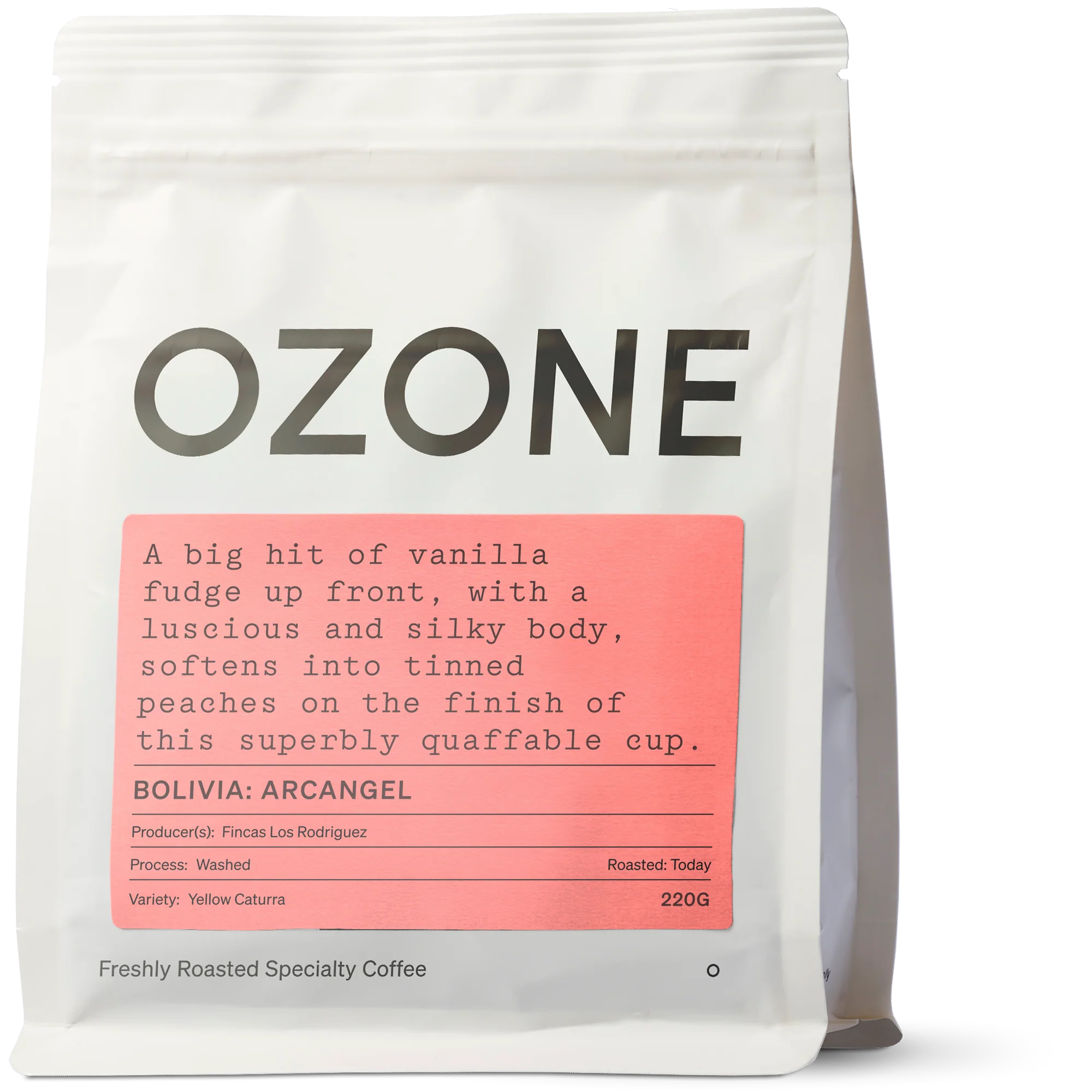
Bolivia: Arcangel, Yellow Caturra, Washed
A big hit of vanilla fudge up front, with a luscious and silky body, softens into tinned peaches on the finish of this superbly quaffable cup.
At the highest point of Finca El Arcangel there stands a towering tree. This tree is the namesake of the Bolivian coffee farm, overlooking everything like a guardian. This is a landscape where coffee trees thrive in balance with native flora such as citrus, papaya, and avocado. This biodiverse environment supports a healthy ecosystem that enhances cup quality - great specialty coffee can only be grown in harmony with its natural surroundings.
The Ideal Recipe For Great Coffee
The Caranavi province sits towards the western edge of Bolivia, on the eastern slopes of the Andes mountain range. Caranavi means "high place" in the Aymara language, one of the indigenous languages spoken in Bolivia. Caranavi province is in a transitional zone between the high Andes and the Amazon basin, it’s known for its lush vegetation and has been dubbed the "Coffee Capital of Bolivia" for its ideal growing conditions and over 13,000 hectares of plantations.
Finca El Arcangel is located at 1,500 metres above sea level, near the town of Copacabana. The farm was first established in 2015 and produced its first coffee harvest in 2017. This 10-hectare farm is managed with precision and care by the Rodriguez family, who are known for their commitment to quality and sustainability. The farm’s rich biodiversity and volcanic soil create ideal conditions for slow cherry maturation and complex flavour development – essential for delicious Bolivian coffee.
The Buena Vista Project
The farm is part of Agricafe’s Buena Vista program, their ambitious project to revive Bolivia’s declining coffee trade. Pedro Rodríguez, along with his daughter Daniela and son Pedro Pablo are the driving force behind Agricafe and Fincas Los Rodríguez. Theirs is a story of innovation and a deep commitment to revitalising the Bolivian specialty coffee industry that was, not so long ago, on the verge of disappearing entirely.
The Rodriguez family have been sourcing coffee from small coffee producers in the Caranavi and Samaipata regions for three decades, but the steady decline of coffee production put the sustainability of their export business in jeopardy. Daniela and Pedro bought land in the Caranavi region to showcase modern practices and educate other producers in sustainable coffee farming, as well as increasing the overall volume at their mills. They have twelve farms in total, and Finca El Arcangel is one of eight in the Caranavi region.
Rather than following traditional Bolivian Coffee farming practices common in the region, they took an extremely methodical, innovative and scientific approach. They consulted leading specialty coffee agronomists from around the world, trialled different varieties and techniques, and carefully documented everything they learned. The results were extraordinary. Their farms became some of the most organised and beautiful in the country - coffee planted in neat rows, meticulously separated by variety, vibrant and healthy and producing exceptional quality and yields. The family also made a commitment to conservation from the outset, aiming to keep 60% of their land as nature reserves with coffee planted as agroforest amongst the trees.
Precision and Perseverance
The farm distinguishes itself from others in the area by separating its red and yellow Caturra varieties. Both varietals have adapted well to the local environment and climate, but the team at El Arcangel accentuate their unique characteristics by ensuring they're grown, picked, and processed individually. The lot that we have here is just the Red Caturra coffee, grown separately on 4 hectares of the farm and processed with strict varietal separation to preserve micro-lot integrity.
El Arcangel employs esqueleto pruning (meaning “skeleton” in English), a regenerative technique that cuts trees back to their structural skeleton to promote vigorous regrowth. The trees are pruned to a height of 1.6 to 1.8 meters, and the lateral branches are reduced to 10 to 15 centimetres. This takes the trees right down to their bare bones, hence the name. Though it requires 12 to 18 months for the trees to recover, coffee cherry production on the new-growth branches can double. This method enhances airflow, reduces disease risk, and improves long-term yield. By rotating pruning cycles across the farm, they ensure consistent output while maintaining plant health and cup quality.
Traceability
- Country: Bolivia
- Region: Yungas
- Municipality: Caranavi
- Nearest town: Copacabana
- Farm: El Arcangel
- Producer: Los Rodriguez
- Elevation: 1,500 m.a.s.l.
- Variety: Yellow Caturra
- Processing method: Washed
Roast Information
Medium‑dark
Roasted with a calm, steady progression, this coffee is carried cleanly through first crack and developed just far enough to reach the very first pops of second before finishing the roast. That precise cut‑off point allows the sweetness and body to fully develop, while stopping early enough to avoid introducing heavier roast flavours.
This approach leans into the coffee’s naturally fudge‑like sweetness and silky mouthfeel, rounding out the acidity and giving the cup a smooth, comforting character. Hints of vanilla and tinned stone fruit are emphasised, with a soft, creamy finish rather than sharp brightness or smokiness. If you enjoy coffees that are rich, approachable and dessert‑leaning, but still clean and well‑defined, this roast is designed to deliver exactly that balance.
Cupping Scores
Cupping Notes: Fudge, vanilla, tinned peaches.
Cup of Excellence Cupping Scores
- Clean Cup: 6/8
- Sweetness: 7/8
- Acidity: 6/8
- Mouthfeel: 7/8
- Flavour: 6.5/8
- Aftertaste: 6/8
- Balance: 6.5/8
- Overall: 6.5/8
- Correction: +36
- Total: 87.5/100
If you'd like to find out more about how we score coffees, make sure to read our blog post "What Do Coffee Cupping Scores Actually Mean?"
Bolivia: Arcangel, Yellow Caturra, Washed
A big hit of vanilla fudge up front, with a luscious and silky body, softens into tinned peaches on the finish of this superbly quaffable cup.
At the highest point of Finca El Arcangel there stands a towering tree. This tree is the namesake of the Bolivian coffee farm, overlooking everything like a guardian. This is a landscape where coffee trees thrive in balance with native flora such as citrus, papaya, and avocado. This biodiverse environment supports a healthy ecosystem that enhances cup quality - great specialty coffee can only be grown in harmony with its natural surroundings.
The Ideal Recipe For Great Coffee
The Caranavi province sits towards the western edge of Bolivia, on the eastern slopes of the Andes mountain range. Caranavi means "high place" in the Aymara language, one of the indigenous languages spoken in Bolivia. Caranavi province is in a transitional zone between the high Andes and the Amazon basin, it’s known for its lush vegetation and has been dubbed the "Coffee Capital of Bolivia" for its ideal growing conditions and over 13,000 hectares of plantations.
Finca El Arcangel is located at 1,500 metres above sea level, near the town of Copacabana. The farm was first established in 2015 and produced its first coffee harvest in 2017. This 10-hectare farm is managed with precision and care by the Rodriguez family, who are known for their commitment to quality and sustainability. The farm’s rich biodiversity and volcanic soil create ideal conditions for slow cherry maturation and complex flavour development – essential for delicious Bolivian coffee.
The Buena Vista Project
The farm is part of Agricafe’s Buena Vista program, their ambitious project to revive Bolivia’s declining coffee trade. Pedro Rodríguez, along with his daughter Daniela and son Pedro Pablo are the driving force behind Agricafe and Fincas Los Rodríguez. Theirs is a story of innovation and a deep commitment to revitalising the Bolivian specialty coffee industry that was, not so long ago, on the verge of disappearing entirely.
The Rodriguez family have been sourcing coffee from small coffee producers in the Caranavi and Samaipata regions for three decades, but the steady decline of coffee production put the sustainability of their export business in jeopardy. Daniela and Pedro bought land in the Caranavi region to showcase modern practices and educate other producers in sustainable coffee farming, as well as increasing the overall volume at their mills. They have twelve farms in total, and Finca El Arcangel is one of eight in the Caranavi region.
Rather than following traditional Bolivian Coffee farming practices common in the region, they took an extremely methodical, innovative and scientific approach. They consulted leading specialty coffee agronomists from around the world, trialled different varieties and techniques, and carefully documented everything they learned. The results were extraordinary. Their farms became some of the most organised and beautiful in the country - coffee planted in neat rows, meticulously separated by variety, vibrant and healthy and producing exceptional quality and yields. The family also made a commitment to conservation from the outset, aiming to keep 60% of their land as nature reserves with coffee planted as agroforest amongst the trees.
Precision and Perseverance
The farm distinguishes itself from others in the area by separating its red and yellow Caturra varieties. Both varietals have adapted well to the local environment and climate, but the team at El Arcangel accentuate their unique characteristics by ensuring they're grown, picked, and processed individually. The lot that we have here is just the Red Caturra coffee, grown separately on 4 hectares of the farm and processed with strict varietal separation to preserve micro-lot integrity.
El Arcangel employs esqueleto pruning (meaning “skeleton” in English), a regenerative technique that cuts trees back to their structural skeleton to promote vigorous regrowth. The trees are pruned to a height of 1.6 to 1.8 meters, and the lateral branches are reduced to 10 to 15 centimetres. This takes the trees right down to their bare bones, hence the name. Though it requires 12 to 18 months for the trees to recover, coffee cherry production on the new-growth branches can double. This method enhances airflow, reduces disease risk, and improves long-term yield. By rotating pruning cycles across the farm, they ensure consistent output while maintaining plant health and cup quality.
Traceability
- Country: Bolivia
- Region: Yungas
- Municipality: Caranavi
- Nearest town: Copacabana
- Farm: El Arcangel
- Producer: Los Rodriguez
- Elevation: 1,500 m.a.s.l.
- Variety: Yellow Caturra
- Processing method: Washed
Roast Information
Medium‑dark
Roasted with a calm, steady progression, this coffee is carried cleanly through first crack and developed just far enough to reach the very first pops of second before finishing the roast. That precise cut‑off point allows the sweetness and body to fully develop, while stopping early enough to avoid introducing heavier roast flavours.
This approach leans into the coffee’s naturally fudge‑like sweetness and silky mouthfeel, rounding out the acidity and giving the cup a smooth, comforting character. Hints of vanilla and tinned stone fruit are emphasised, with a soft, creamy finish rather than sharp brightness or smokiness. If you enjoy coffees that are rich, approachable and dessert‑leaning, but still clean and well‑defined, this roast is designed to deliver exactly that balance.
Cupping Scores
Cupping Notes: Fudge, vanilla, tinned peaches.
Cup of Excellence Cupping Scores
- Clean Cup: 6/8
- Sweetness: 7/8
- Acidity: 6/8
- Mouthfeel: 7/8
- Flavour: 6.5/8
- Aftertaste: 6/8
- Balance: 6.5/8
- Overall: 6.5/8
- Correction: +36
- Total: 87.5/100
If you'd like to find out more about how we score coffees, make sure to read our blog post "What Do Coffee Cupping Scores Actually Mean?"
Original: $12.53
-65%$12.53
$4.39Description
Bolivia: Arcangel, Yellow Caturra, Washed
A big hit of vanilla fudge up front, with a luscious and silky body, softens into tinned peaches on the finish of this superbly quaffable cup.
At the highest point of Finca El Arcangel there stands a towering tree. This tree is the namesake of the Bolivian coffee farm, overlooking everything like a guardian. This is a landscape where coffee trees thrive in balance with native flora such as citrus, papaya, and avocado. This biodiverse environment supports a healthy ecosystem that enhances cup quality - great specialty coffee can only be grown in harmony with its natural surroundings.
The Ideal Recipe For Great Coffee
The Caranavi province sits towards the western edge of Bolivia, on the eastern slopes of the Andes mountain range. Caranavi means "high place" in the Aymara language, one of the indigenous languages spoken in Bolivia. Caranavi province is in a transitional zone between the high Andes and the Amazon basin, it’s known for its lush vegetation and has been dubbed the "Coffee Capital of Bolivia" for its ideal growing conditions and over 13,000 hectares of plantations.
Finca El Arcangel is located at 1,500 metres above sea level, near the town of Copacabana. The farm was first established in 2015 and produced its first coffee harvest in 2017. This 10-hectare farm is managed with precision and care by the Rodriguez family, who are known for their commitment to quality and sustainability. The farm’s rich biodiversity and volcanic soil create ideal conditions for slow cherry maturation and complex flavour development – essential for delicious Bolivian coffee.
The Buena Vista Project
The farm is part of Agricafe’s Buena Vista program, their ambitious project to revive Bolivia’s declining coffee trade. Pedro Rodríguez, along with his daughter Daniela and son Pedro Pablo are the driving force behind Agricafe and Fincas Los Rodríguez. Theirs is a story of innovation and a deep commitment to revitalising the Bolivian specialty coffee industry that was, not so long ago, on the verge of disappearing entirely.
The Rodriguez family have been sourcing coffee from small coffee producers in the Caranavi and Samaipata regions for three decades, but the steady decline of coffee production put the sustainability of their export business in jeopardy. Daniela and Pedro bought land in the Caranavi region to showcase modern practices and educate other producers in sustainable coffee farming, as well as increasing the overall volume at their mills. They have twelve farms in total, and Finca El Arcangel is one of eight in the Caranavi region.
Rather than following traditional Bolivian Coffee farming practices common in the region, they took an extremely methodical, innovative and scientific approach. They consulted leading specialty coffee agronomists from around the world, trialled different varieties and techniques, and carefully documented everything they learned. The results were extraordinary. Their farms became some of the most organised and beautiful in the country - coffee planted in neat rows, meticulously separated by variety, vibrant and healthy and producing exceptional quality and yields. The family also made a commitment to conservation from the outset, aiming to keep 60% of their land as nature reserves with coffee planted as agroforest amongst the trees.
Precision and Perseverance
The farm distinguishes itself from others in the area by separating its red and yellow Caturra varieties. Both varietals have adapted well to the local environment and climate, but the team at El Arcangel accentuate their unique characteristics by ensuring they're grown, picked, and processed individually. The lot that we have here is just the Red Caturra coffee, grown separately on 4 hectares of the farm and processed with strict varietal separation to preserve micro-lot integrity.
El Arcangel employs esqueleto pruning (meaning “skeleton” in English), a regenerative technique that cuts trees back to their structural skeleton to promote vigorous regrowth. The trees are pruned to a height of 1.6 to 1.8 meters, and the lateral branches are reduced to 10 to 15 centimetres. This takes the trees right down to their bare bones, hence the name. Though it requires 12 to 18 months for the trees to recover, coffee cherry production on the new-growth branches can double. This method enhances airflow, reduces disease risk, and improves long-term yield. By rotating pruning cycles across the farm, they ensure consistent output while maintaining plant health and cup quality.
Traceability
- Country: Bolivia
- Region: Yungas
- Municipality: Caranavi
- Nearest town: Copacabana
- Farm: El Arcangel
- Producer: Los Rodriguez
- Elevation: 1,500 m.a.s.l.
- Variety: Yellow Caturra
- Processing method: Washed
Roast Information
Medium‑dark
Roasted with a calm, steady progression, this coffee is carried cleanly through first crack and developed just far enough to reach the very first pops of second before finishing the roast. That precise cut‑off point allows the sweetness and body to fully develop, while stopping early enough to avoid introducing heavier roast flavours.
This approach leans into the coffee’s naturally fudge‑like sweetness and silky mouthfeel, rounding out the acidity and giving the cup a smooth, comforting character. Hints of vanilla and tinned stone fruit are emphasised, with a soft, creamy finish rather than sharp brightness or smokiness. If you enjoy coffees that are rich, approachable and dessert‑leaning, but still clean and well‑defined, this roast is designed to deliver exactly that balance.
Cupping Scores
Cupping Notes: Fudge, vanilla, tinned peaches.
Cup of Excellence Cupping Scores
- Clean Cup: 6/8
- Sweetness: 7/8
- Acidity: 6/8
- Mouthfeel: 7/8
- Flavour: 6.5/8
- Aftertaste: 6/8
- Balance: 6.5/8
- Overall: 6.5/8
- Correction: +36
- Total: 87.5/100
If you'd like to find out more about how we score coffees, make sure to read our blog post "What Do Coffee Cupping Scores Actually Mean?"