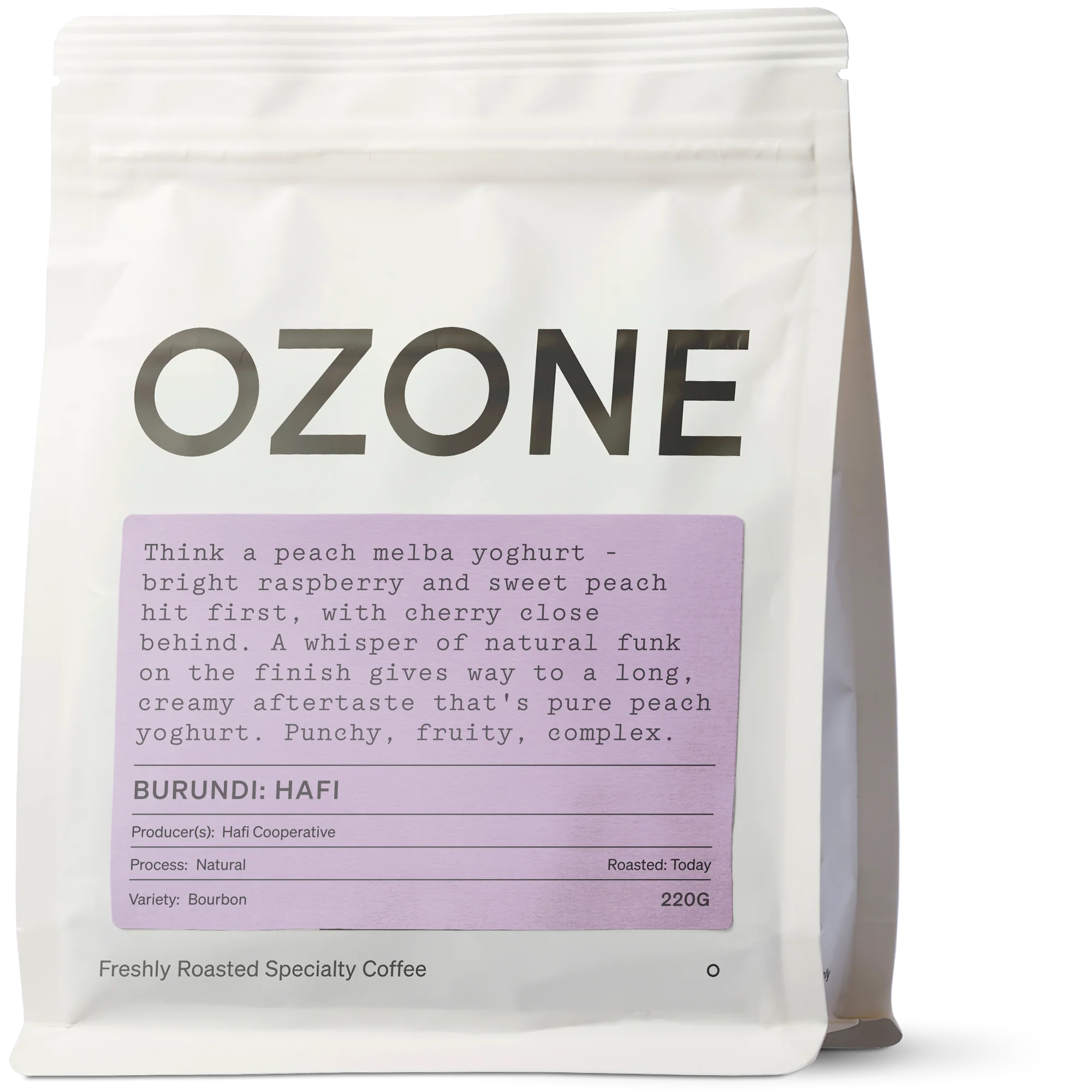
Burundi: Hafi
Burundi: Hafi, Bourbon, Natural
Think a peach melba yoghurt – bright raspberry and sweet peach hit first, with cherry close behind. A whisper of natural funk on the finish gives way to a long, creamy aftertaste that's pure peach yoghurt. Punchy, fruity, complex.
Sometimes the best coffee comes from the most unlikely circumstances. In the remote hills of Muyinga Province in northeastern Burundi, the nearest wet mill used to be over a day's journey away – too far to haul freshly picked cherries and still expect anything good at the other end. So the farmers did what resourceful people do: they worked with what they had. They dried their coffee whole on raised beds, experimented with anaerobic fermentation, and over time became genuinely exceptional natural processors. Hafi means “near” in Kirundi – a name born from the farmers' aspiration to have processing infrastructure closer to home. Whether that dream is fully realised or still unfolding, what's certain is that isolation bred innovation here, and the cup quality speaks for itself.
The cooperative is made up of around 2,000 smallholder farmers, and their coffee is exported by JNP Coffee, founded in 2012 by Jeanine Niyonzima-Aroian. Jeanine grew up in Bujumbura, Burundi's largest city, where her mother's stories of the family cultivating coffee in Ngozi Province to pay for school fees left a lasting mark. After earning an MBA from Northwestern's Kellogg School and spending over two decades in international business, she found her way back to Burundi – and to coffee – after recognising the potential of the country's exceptional but largely unknown speciality lots at a Cup of Excellence competition. Today she's a licensed Q Grader, a certified Q Processor, and sits on the SCA Board of Directors.
Central to JNP's work is the Dushimé® programme – dushimé meaning “let's be thankful” in Kirundi. It's beautifully simple: after selling each harvest to roasters and buyers around the world, JNP returns to the farmers with a second payment – an additional premium of 20–40 cents per pound that reflects the price their quality achieved on the global market. To date, those disbursements have passed the half-million-dollar mark, benefiting more than 10,000 women and their families. The programme also supports financial literacy education and leadership training, helping farmers – many of them women – build long-term independence. When Jeanine visits to distribute the second payment, the farmers dance and sing. She joins in.
It's worth noting that what's labelled “Bourbon” in Burundi is really a family of heirloom cultivars. Many of the trees here are decades old – legacy plantings from the colonial era – and the country's smallholders grow a mix of sub-varieties including Jackson, Mbirizi, and Kent, all sheltering under the Bourbon name. The average farmer is unlikely to know the exact genetic strain on their plot, so the catchall label sticks. What matters in the cup is that these old-growth Bourbon types, planted in volcanic soil at altitude, deliver the sweetness, body, and fruit complexity that Burundi is increasingly celebrated for. If you'd like to dig deeper, our varietal guide to Bourbon covers its full history and why it remains one of speciality coffee's most important plants.
Traceability
- Country: Burundi
- Region: Muyinga Province
- Mill: Hafi Cooperative
- Producers: Smallholder Farmers
- Altitude: 1,715 m.a.s.l.
- Processing Method: Natural
- Varietal: Bourbon
- Exporter: JNP Coffee
- Co-op Size: ~2,000 smallholder farmers
- Programme: Dushimé® (second payment premium)
- Harvest: February – June (Burundi's main seasonal window)
Cupping Scores
Tasting Notes: Raspberry, peach yoghurt, cherry.
Cup of Excellence Cupping Scores
- Clean Cup: 7/8
- Sweetness: 6.5/8
- Acidity: 7/8
- Mouthfeel: 6/8
- Flavour: 7/8
- Aftertaste: 7/8
- Balance: 6/8
- Overall: 6.5/8
- Correction: +36
- Total: 89/100
If you'd like to find out more about how we score coffees, make sure to read our blog post “What Do Coffee Cupping Scores Actually Mean?”
Roasting Information
Medium. Naturals always ask you to walk a line, and this one's no different. Push it too light and you risk letting the fermentation character run unchecked – all funk, no finesse. Take it too far and you'll flatten the acidity that gives this coffee its energy. The sweet spot is a fairly quick roast with enough development to bring out Bourbon's inherent creaminess and body, while keeping things moving briskly enough that the bright, fruity top notes stay intact. Think of it as giving the sweetness room to catch up with the acidity without overtaking it. The natural processing has already done a lot of the heavy lifting in terms of complexity – the roast just needs to stay out of its way and let that come through cleanly.
Burundi: Hafi, Bourbon, Natural
Think a peach melba yoghurt – bright raspberry and sweet peach hit first, with cherry close behind. A whisper of natural funk on the finish gives way to a long, creamy aftertaste that's pure peach yoghurt. Punchy, fruity, complex.
Sometimes the best coffee comes from the most unlikely circumstances. In the remote hills of Muyinga Province in northeastern Burundi, the nearest wet mill used to be over a day's journey away – too far to haul freshly picked cherries and still expect anything good at the other end. So the farmers did what resourceful people do: they worked with what they had. They dried their coffee whole on raised beds, experimented with anaerobic fermentation, and over time became genuinely exceptional natural processors. Hafi means “near” in Kirundi – a name born from the farmers' aspiration to have processing infrastructure closer to home. Whether that dream is fully realised or still unfolding, what's certain is that isolation bred innovation here, and the cup quality speaks for itself.
The cooperative is made up of around 2,000 smallholder farmers, and their coffee is exported by JNP Coffee, founded in 2012 by Jeanine Niyonzima-Aroian. Jeanine grew up in Bujumbura, Burundi's largest city, where her mother's stories of the family cultivating coffee in Ngozi Province to pay for school fees left a lasting mark. After earning an MBA from Northwestern's Kellogg School and spending over two decades in international business, she found her way back to Burundi – and to coffee – after recognising the potential of the country's exceptional but largely unknown speciality lots at a Cup of Excellence competition. Today she's a licensed Q Grader, a certified Q Processor, and sits on the SCA Board of Directors.
Central to JNP's work is the Dushimé® programme – dushimé meaning “let's be thankful” in Kirundi. It's beautifully simple: after selling each harvest to roasters and buyers around the world, JNP returns to the farmers with a second payment – an additional premium of 20–40 cents per pound that reflects the price their quality achieved on the global market. To date, those disbursements have passed the half-million-dollar mark, benefiting more than 10,000 women and their families. The programme also supports financial literacy education and leadership training, helping farmers – many of them women – build long-term independence. When Jeanine visits to distribute the second payment, the farmers dance and sing. She joins in.
It's worth noting that what's labelled “Bourbon” in Burundi is really a family of heirloom cultivars. Many of the trees here are decades old – legacy plantings from the colonial era – and the country's smallholders grow a mix of sub-varieties including Jackson, Mbirizi, and Kent, all sheltering under the Bourbon name. The average farmer is unlikely to know the exact genetic strain on their plot, so the catchall label sticks. What matters in the cup is that these old-growth Bourbon types, planted in volcanic soil at altitude, deliver the sweetness, body, and fruit complexity that Burundi is increasingly celebrated for. If you'd like to dig deeper, our varietal guide to Bourbon covers its full history and why it remains one of speciality coffee's most important plants.
Traceability
- Country: Burundi
- Region: Muyinga Province
- Mill: Hafi Cooperative
- Producers: Smallholder Farmers
- Altitude: 1,715 m.a.s.l.
- Processing Method: Natural
- Varietal: Bourbon
- Exporter: JNP Coffee
- Co-op Size: ~2,000 smallholder farmers
- Programme: Dushimé® (second payment premium)
- Harvest: February – June (Burundi's main seasonal window)
Cupping Scores
Tasting Notes: Raspberry, peach yoghurt, cherry.
Cup of Excellence Cupping Scores
- Clean Cup: 7/8
- Sweetness: 6.5/8
- Acidity: 7/8
- Mouthfeel: 6/8
- Flavour: 7/8
- Aftertaste: 7/8
- Balance: 6/8
- Overall: 6.5/8
- Correction: +36
- Total: 89/100
If you'd like to find out more about how we score coffees, make sure to read our blog post “What Do Coffee Cupping Scores Actually Mean?”
Roasting Information
Medium. Naturals always ask you to walk a line, and this one's no different. Push it too light and you risk letting the fermentation character run unchecked – all funk, no finesse. Take it too far and you'll flatten the acidity that gives this coffee its energy. The sweet spot is a fairly quick roast with enough development to bring out Bourbon's inherent creaminess and body, while keeping things moving briskly enough that the bright, fruity top notes stay intact. Think of it as giving the sweetness room to catch up with the acidity without overtaking it. The natural processing has already done a lot of the heavy lifting in terms of complexity – the roast just needs to stay out of its way and let that come through cleanly.
Original: $13.62
-65%$13.62
$4.77Description
Burundi: Hafi, Bourbon, Natural
Think a peach melba yoghurt – bright raspberry and sweet peach hit first, with cherry close behind. A whisper of natural funk on the finish gives way to a long, creamy aftertaste that's pure peach yoghurt. Punchy, fruity, complex.
Sometimes the best coffee comes from the most unlikely circumstances. In the remote hills of Muyinga Province in northeastern Burundi, the nearest wet mill used to be over a day's journey away – too far to haul freshly picked cherries and still expect anything good at the other end. So the farmers did what resourceful people do: they worked with what they had. They dried their coffee whole on raised beds, experimented with anaerobic fermentation, and over time became genuinely exceptional natural processors. Hafi means “near” in Kirundi – a name born from the farmers' aspiration to have processing infrastructure closer to home. Whether that dream is fully realised or still unfolding, what's certain is that isolation bred innovation here, and the cup quality speaks for itself.
The cooperative is made up of around 2,000 smallholder farmers, and their coffee is exported by JNP Coffee, founded in 2012 by Jeanine Niyonzima-Aroian. Jeanine grew up in Bujumbura, Burundi's largest city, where her mother's stories of the family cultivating coffee in Ngozi Province to pay for school fees left a lasting mark. After earning an MBA from Northwestern's Kellogg School and spending over two decades in international business, she found her way back to Burundi – and to coffee – after recognising the potential of the country's exceptional but largely unknown speciality lots at a Cup of Excellence competition. Today she's a licensed Q Grader, a certified Q Processor, and sits on the SCA Board of Directors.
Central to JNP's work is the Dushimé® programme – dushimé meaning “let's be thankful” in Kirundi. It's beautifully simple: after selling each harvest to roasters and buyers around the world, JNP returns to the farmers with a second payment – an additional premium of 20–40 cents per pound that reflects the price their quality achieved on the global market. To date, those disbursements have passed the half-million-dollar mark, benefiting more than 10,000 women and their families. The programme also supports financial literacy education and leadership training, helping farmers – many of them women – build long-term independence. When Jeanine visits to distribute the second payment, the farmers dance and sing. She joins in.
It's worth noting that what's labelled “Bourbon” in Burundi is really a family of heirloom cultivars. Many of the trees here are decades old – legacy plantings from the colonial era – and the country's smallholders grow a mix of sub-varieties including Jackson, Mbirizi, and Kent, all sheltering under the Bourbon name. The average farmer is unlikely to know the exact genetic strain on their plot, so the catchall label sticks. What matters in the cup is that these old-growth Bourbon types, planted in volcanic soil at altitude, deliver the sweetness, body, and fruit complexity that Burundi is increasingly celebrated for. If you'd like to dig deeper, our varietal guide to Bourbon covers its full history and why it remains one of speciality coffee's most important plants.
Traceability
- Country: Burundi
- Region: Muyinga Province
- Mill: Hafi Cooperative
- Producers: Smallholder Farmers
- Altitude: 1,715 m.a.s.l.
- Processing Method: Natural
- Varietal: Bourbon
- Exporter: JNP Coffee
- Co-op Size: ~2,000 smallholder farmers
- Programme: Dushimé® (second payment premium)
- Harvest: February – June (Burundi's main seasonal window)
Cupping Scores
Tasting Notes: Raspberry, peach yoghurt, cherry.
Cup of Excellence Cupping Scores
- Clean Cup: 7/8
- Sweetness: 6.5/8
- Acidity: 7/8
- Mouthfeel: 6/8
- Flavour: 7/8
- Aftertaste: 7/8
- Balance: 6/8
- Overall: 6.5/8
- Correction: +36
- Total: 89/100
If you'd like to find out more about how we score coffees, make sure to read our blog post “What Do Coffee Cupping Scores Actually Mean?”
Roasting Information
Medium. Naturals always ask you to walk a line, and this one's no different. Push it too light and you risk letting the fermentation character run unchecked – all funk, no finesse. Take it too far and you'll flatten the acidity that gives this coffee its energy. The sweet spot is a fairly quick roast with enough development to bring out Bourbon's inherent creaminess and body, while keeping things moving briskly enough that the bright, fruity top notes stay intact. Think of it as giving the sweetness room to catch up with the acidity without overtaking it. The natural processing has already done a lot of the heavy lifting in terms of complexity – the roast just needs to stay out of its way and let that come through cleanly.


